Sam’s paper published on PNAS

Sam, Minliang, and Natalie’s halide perovskite nanowire laser paper is published on PNAS and highlighted by LBNL news.

Nanowire lasers are miniaturized light sources with great potential for integration into optoelectronic circuits. Many of the current nanowire lasers either require extreme conditions for synthesis or suffer from poor operational stability. We synthesize nanowires of a promising set of compositions, the cesium lead halides, and accomplish this under near-ambient conditions. These nanowires act as efficient laser cavities and are capable of lasing with relatively low excitation thresholds. They also demonstrate unprecedented stability for a perovskite-based nanowire laser and offer a new nanoscale platform for future study.

Screen Shot 2016-08-19 at 10.55.31 AM.png


Fan& Letian’s paper published on ACS Nano

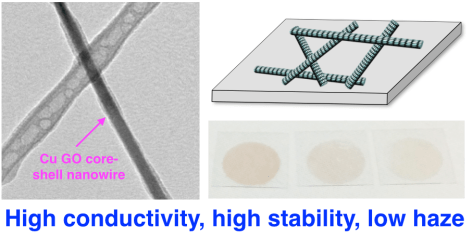
Fan and Letian’s copper-graphene oxide core-shell nanowire paper is published on ACS Nano.

Copper nanowire (Cu NW) based transparent conductors are promising candidates to replace ITO (indium–tin-oxide) owing to the high electrical conductivity and low-cost of copper. However, the relatively low performance and poor stability of Cu NWs under ambient conditions limit the practical application of these devices. Here, we report a solution-based approach to wrap graphene oxide (GO) nanosheets on the surface of ultrathin copper nanowires. By mild thermal annealing, GO can be reduced and high quality Cu r-GO core–shell NWs can be obtained. High performance transparent conducting films were fabricated with these ultrathin core–shell nanowires and excellent optical and electric performance was achieved. The core–shell NW structure enables the production of highly stable conducting films (over 200 days stored in air), which have comparable performance to ITO and silver NW thin films (sheet resistance ∼28 Ω/sq, haze ∼2% at transmittance of ∼90%).

TOC.png

Letian’s paper published on Science

Letian, Andrew, and Yi’s work on 2D hybrid perovskites is published on Science.

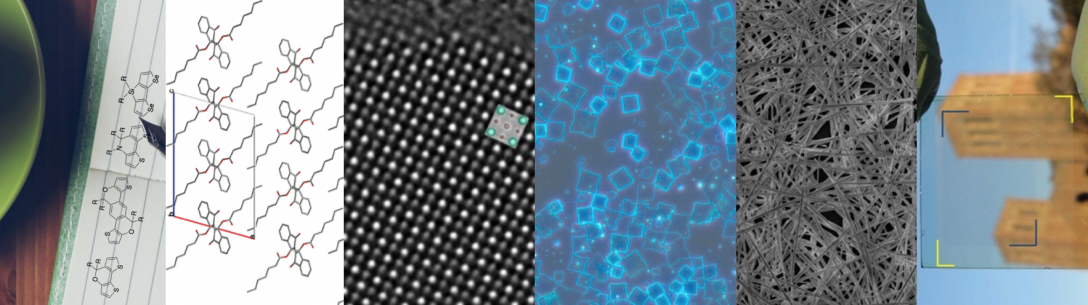
Bulk crystals and thick films of inorganic-organic perovskite materials such as CH3NH3PbI3 have shown promise as active material for solar cells. Dou et al. show that thin films—a single unit cell or a few unit cells thick—of a related composition, (C4H9NH3)2PbBr4, form squares with edges several micrometers long. These materials exhibit strong and tunable blue photoluminescence.

Screen Shot 2016-08-19 at 10.45.43 AM

This work is highlighted by Nature Nanotechnology, LBNL News, etc.